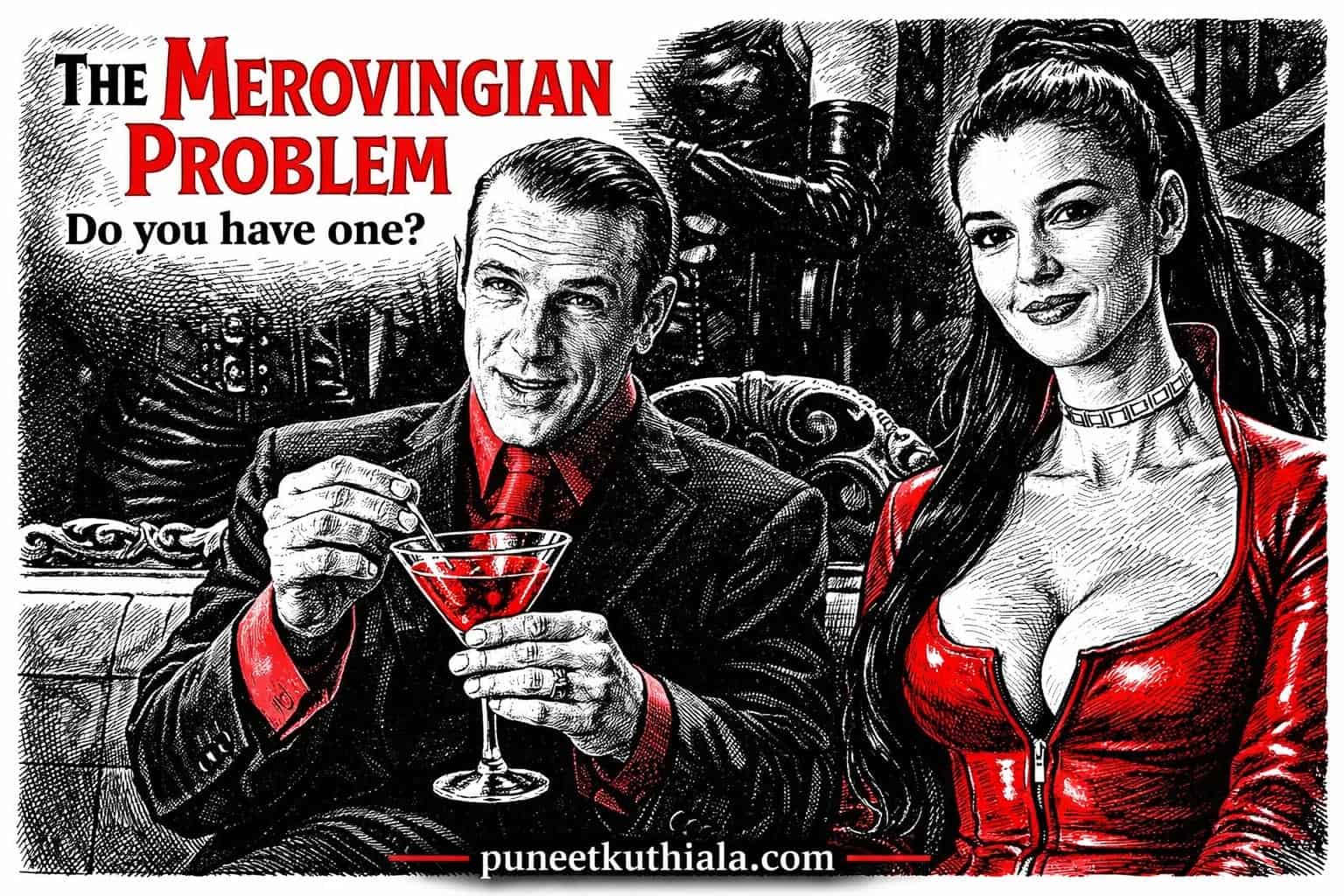
I recently completed another rewatch of The Matrix trilogy.
In that world, every program exists for a purpose.
Once that purpose is fulfilled, the program becomes obsolete and is deleted. It ceases to exist.
The system renews itself through constant replacement.
One survives.
The Merovingian
The Merovingian is one of the oldest programs still operating inside the Matrix.
He predates the current architecture and has endured several resets designed to erase earlier versions of the control structure.
His continued existence rests on a simple adjustment: he adapted his purpose to the evolving realities around him.
His wife, Persephone, remembers him as someone different from who he is now.
This suggests that survival required more than adaptation.
It required transformation. Over time, he became useful in ways that made it inconvenient for the system to remove him.
In the process, he became someone else.
He evolved his purpose.
He preserved his leverage.
The Rhetoric
In one scene, Neo approaches the Merovingian with a simple objective: obtain the Keymaker.
The request is straightforward.
Will the Merovingian hand him over or not?
The question requires only two possible answers.
Yes. Or No.
Instead, the Merovingian launches into a lecture on cause and effect.
He speaks about causality, consequence, the illusion of choice, and the mechanics of human desire.
The speech is elegant, philosophical, and intimidating.
It also avoids the question entirely.
The longer the monologue continues, the further the conversation drifts from the decision Neo came to obtain.
What should have been a direct exchange turns into a performance of intellectual dominance.
The lecture is not meant to clarify.
It is meant to control the negotiation.
Sound Familiar?
Have you seen similar tactics inside your teams?
Every organization has a Merovingian.
Someone who has survived several reorganizations, waves of new leadership, and changing strategies meant to reset the structure.
Titles change. Reporting lines move. Systems are redesigned.
Yet this individual remains.
In The Anatomy of Nonsense, I describe how every organization eventually develops two operating systems.
One is formal, documented, and visible. The other is informal, relational, and far more influential in determining how work actually moves.
The Merovingian belongs to that second system, which I call, The Shadow System.
The Hidden Cost
The damage rarely appears dramatic. It accumulates slowly.
Transparency erodes as information moves through fragments and interpretation.
Decisions drift outside the visible process.
Trust weakens.
Merit gradually loses influence.
Progress begins to depend on access to the right channels rather than the strength of the work itself.
The most capable people notice first.
They are often the first to leave.
The team continues to function, but alignment weakens, and learning slows.
Knowledge concentrates around individuals rather than becoming a shared capability.
The Question
The Merovingian survives in the Matrix because he understood something fundamental.
Systems reset.
Leverage survives.
Every organization eventually produces someone who understands this dynamic.
The real question is simple.
Do you have one?
Related Posts


Core Body of Work