

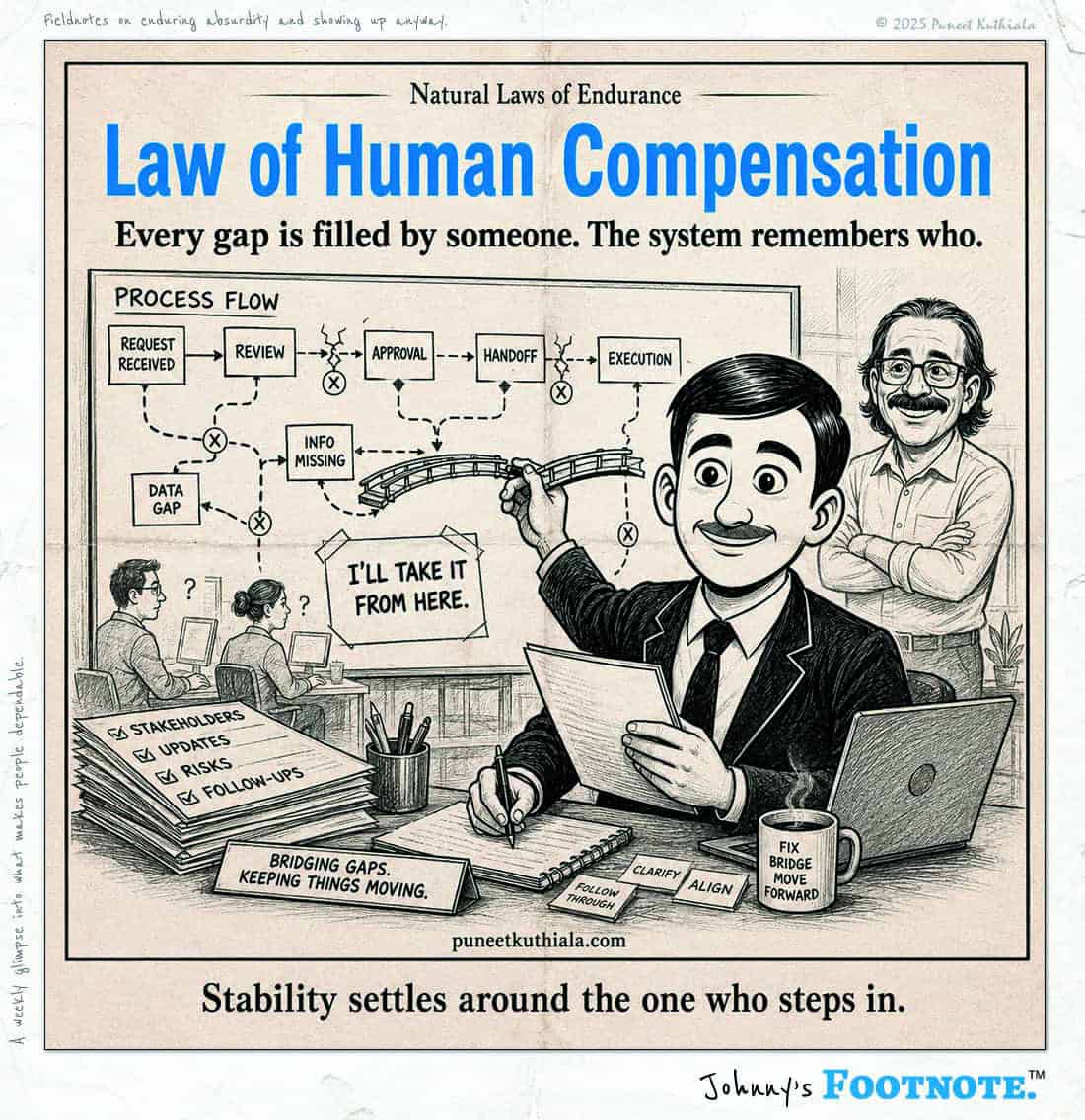
Law of Human Compensation
Every gap is filled by someone. The system remembers who.
There was supposed to be a process to handle the handoff. It did not handle it completely.
It had not done so for some time.
There was a step missing, and it had been missing since before John arrived.
The gap was not new.
It had simply been accepted.
First, as an exception. But gradually, it was accepted as systemic: how the system continued to function despite what it lacked.
Everyone who encountered it had done the same thing.
They worked around it.
Quietly. Individually.
Without escalation.
Addressing it felt more demanding than covering it.
John did the same.
He stepped around the gap.
He invested his own time and attention in it.
A small adjustment that added forty minutes to every cycle.
It was not dramatic. It did not interrupt the flow.
It allowed the work to pass through without resistance.
Every gap the system leaves open, a person fills.
The system rarely notices. It does not adapt.
It reorganizes around those who compensate for this gap.
It continues to return to them.
The process remained unchanged.
The documents still described it as complete.
The handoff was still considered handled.
Nothing in the system reflected what was actually happening.
Only the people carrying the system knew.
John did not make it visible.
He allowed the official version to stand unchanged.
He carried it, as others had before him.
But unlike others, it was not a solution for John.
He knew he was compensating for something that should not require it.
Many had accepted the workaround as the final state. John did not.
This was John’s way of working.
He adapted to the system’s gaps and, at times, worked to close them, when he could.
This habit shaped what he became.
The way a broken process is carried out reveals more than whether it is ever corrected.
Stability settles around the one who steps in.
Meet John's Colleagues. They are here (& almost everywhere).
Follow the Genesis of the Laws
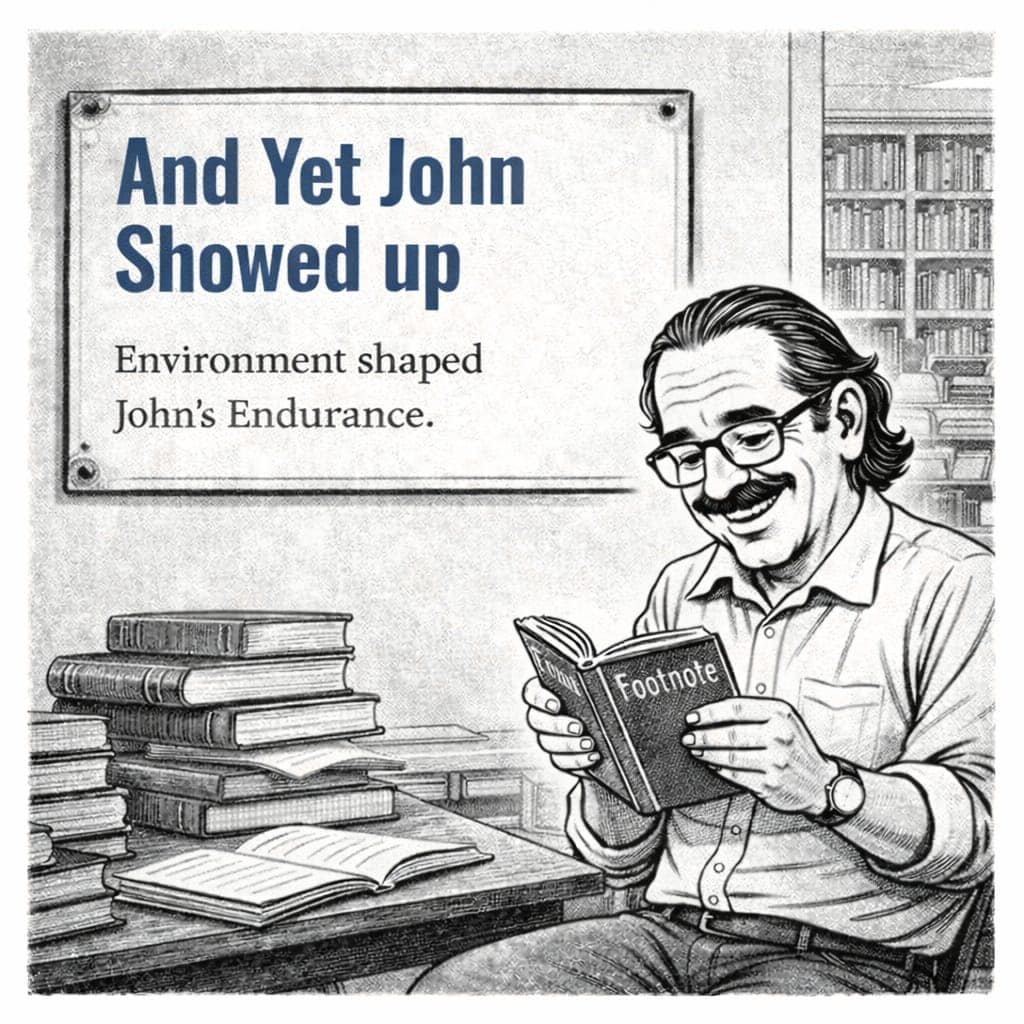

Humor from The Footnote





Core Body of Work


Explore More


