

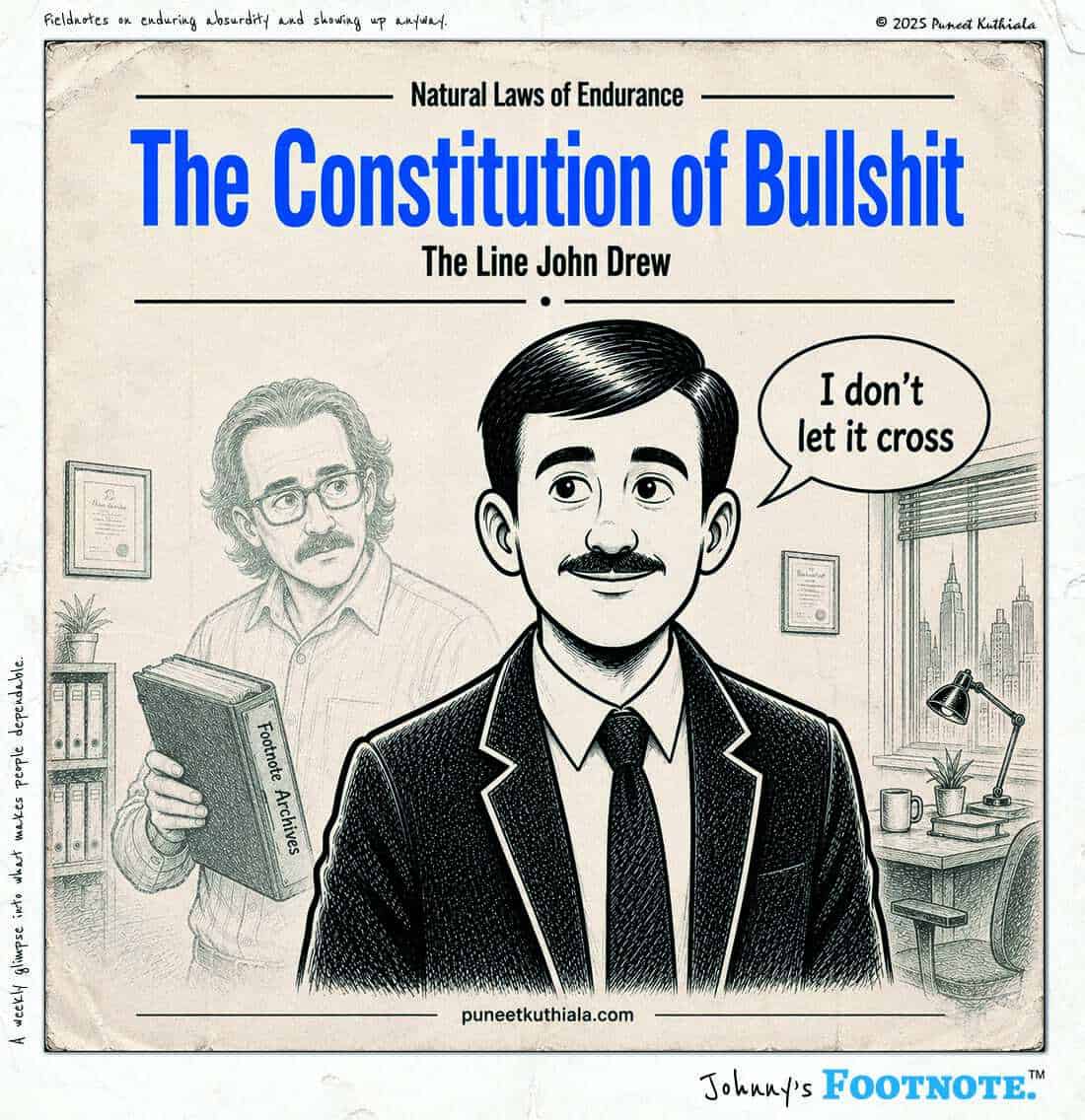
The Constitution of Bullshit
The Line John Drew
John had begun to suspect that a constitution existed.
There was no published copy, no owner, and no version history. No one appeared to have ratified it.
Yet most people seemed to observe it faithfully.
John saw it in decisions that defeated their own objectives.
In priorities that multiplied while none were removed.
In compromises that weakened the result, then returned as instructions to improve it.
He saw it most clearly in what happened next.
The Dependable
Whatever the system left unresolved moved towards the person most likely to resolve it.
- The instructions were confusing and lacked context, so John stayed late to clarify them.
- A dependency was delayed, a meeting failed to reach a decision, and John adjusted his week to make up for the setback.
- A compromise was reached that everyone accepted but no one truly believed in, and John took on the risk of maintaining it.
- A confident directive masked poor judgment, and John accepted the consequences while being praised for his accountability.
The arrangement worked remarkably well for everyone except John.
The Constitution did not require the system to solve its contradictions.
It required someone dependable to absorb them.
John answered that requirement.
He moved ahead because the task was important. He addressed the gaps since leaving work incomplete had repercussions. He took on more responsibilities because he understood the potential outcomes of inaction.
The system noticed.
Reliability became availability. Availability became expectation. Expectation became obligation.
The Cost of Competence
John’s competence masked poor decisions, making them seem sound.
- His patience turned vague instructions into tangible deliverables.
- His endurance kept flawed plans progressing well beyond the point when their faults should have been evident.
- He had believed that this was responsibility.
Then he began to see the cost of that belief.
- Each rescue prevented a bad decision from being scrutinized.
- Each recovered delay hid its underlying cause.
- Each corrected instruction serves as proof that the process was successful.
John worked towards the outcome, while also safeguarding the system from its own potential consequences.
His sense of responsibility started to become clearer.
He would maintain responsibility for his work. He would think logically even when others did not. He would take action when necessary to achieve results. He would stay put when leaving could jeopardize something valuable.
However, responsibility would not require him to accept every contradiction.
The Boundary
John was capable of enduring confusion, delays, and poor judgment, as he had experienced all of these before.
He was able to fix an incomplete instruction, restore a missing dependency, and save a plan that had been approved before it was fully understood.
He was built to handle such situations.
These failures wasted time, consumed effort, and transferred responsibility.
They did not yet cross his line.
The line appeared when the consequences moved beyond the project.
- When a design choice led to a product hazard,
- When a hidden defect endangered customers or employees,
- The safety was sacrificed to meet a tight schedule, the situation worsened.
- Compliance was viewed as a hurdle rather than a responsibility,
- Directives compelled actions like ignoring laws, concealing evidence, or pushing risky decisions into the market
At that point, endurance turned into complicity.
The Line
Once he saw this line, John would no longer mend the work quietly.
He would contest the decision, document the risk, and present the consequences to those in authority. When they decided to proceed, they would do so without his approval and without the safeguard of his professional judgment.
The Constitution has always depended on trustworthy individuals to transform poor decisions into effective results.
Crossing the line required something more.
It asked John to make a harmful decision executable.
That was the line he drew.
He would work through disorder.
He would recover what could still be recovered.
He would not leverage his expertise to distribute a faulty product, risk unnecessary danger to others, or make an illegal decision seem professionally justified.
His responsibility remained with the outcome.
The result went beyond just the product, schedule, and approved plan.
It encompassed those who would use, operate, depend on, and be affected by it.
John could survive the Constitution.
He would not let it cross the line.
Meet John's Colleagues. They are here (& almost everywhere).
Follow the Genesis of the Laws

Humor from The Footnote


Core Body of Work


Explore More


