


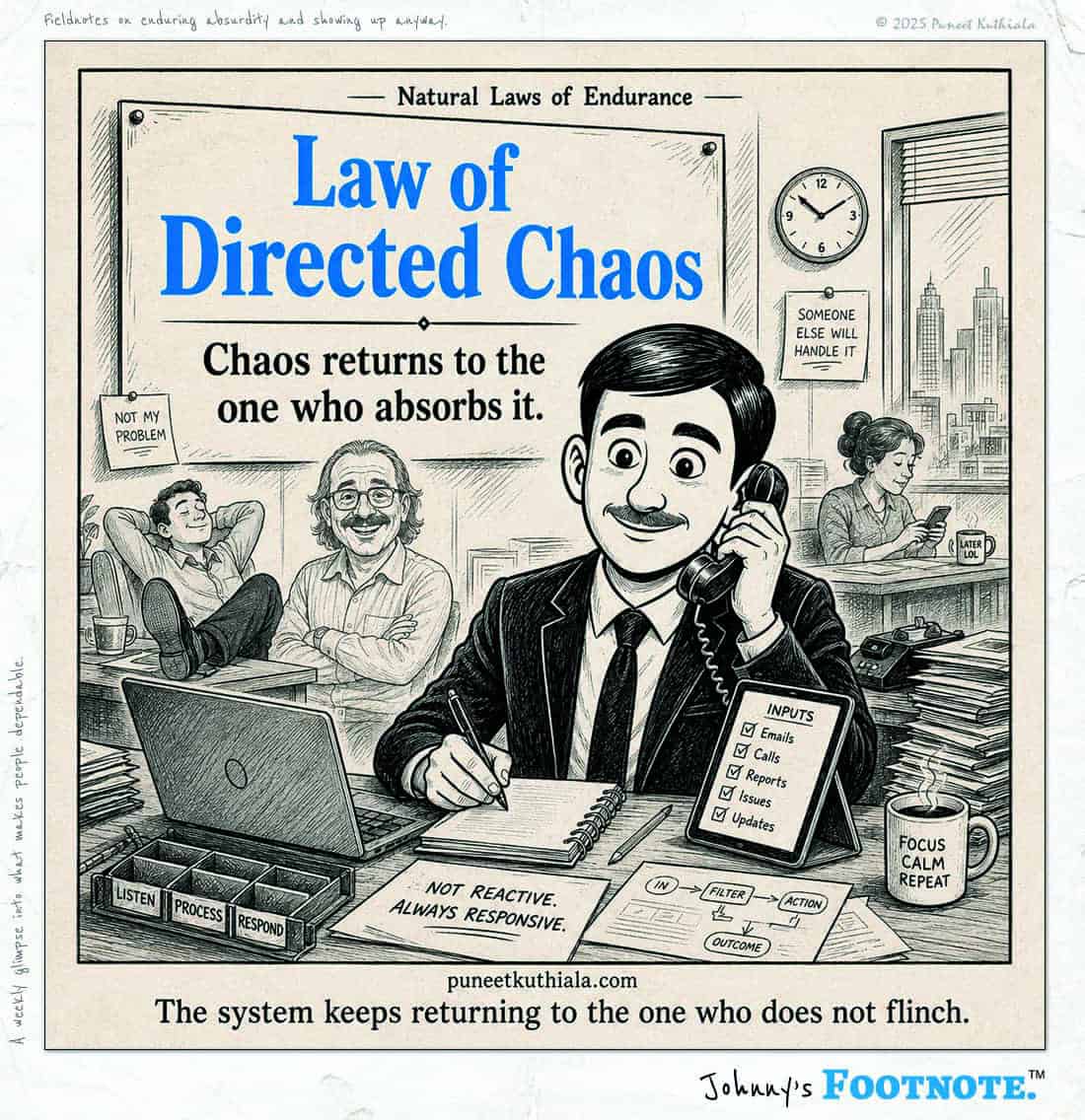
Law of Directed Chaos
Chaos returns to the one who absorbs it.
The first crisis reached John by accident.
The responsible person was unavailable.
The work did not pause. It never does.
It had to be completed. It found John.
John handled it.
He cleaned it up without noise.
He said little about how close it came to going badly.
No one in the system noted it. I wrote about it in The Footnote.
When something unstable appears, it does not stay where it cannot be handled. It moves until it reaches someone who can handle it. It is a pattern in the system.
The second time was different.
The crisis did not arrive in John’s hands by chance.
It moved as if it had direction, though no one stated it.
The one who had stepped away earlier had already moved on.
That pattern would repeat. Absence at the moment ownership is required.
Each time, someone, somewhere, had already decided who could handle the crisis.
No discussions. No records. But something had been registered in the system.
The last time this crisis passed through John, nothing broke.
That was sufficient.
The system does not need many instances to identify stability.
Once it does, it stops looking elsewhere.
By the time John noticed the change, this fact had settled in the system.
What had been incidental became expected.
What arrived as overflow began arriving with intent.
He was no longer encountering chaos.
He had become the point to which it was directed.
No one named it. No one framed it as recognition. There was no adjustment in role or authority. Only a quiet but firm change in the flow.
This was a shift in how the system perceived John.
It was an assignment made without appearing as one. Absorbing chaos is not a compliment.
It is how the system marks you without naming you.
The system keeps returning to the one who does not flinch.
Meet John's Colleagues. They are here (& almost everywhere).
Follow the Genesis of the Laws




Humor from The Footnote










Core Body of Work


Explore More


