


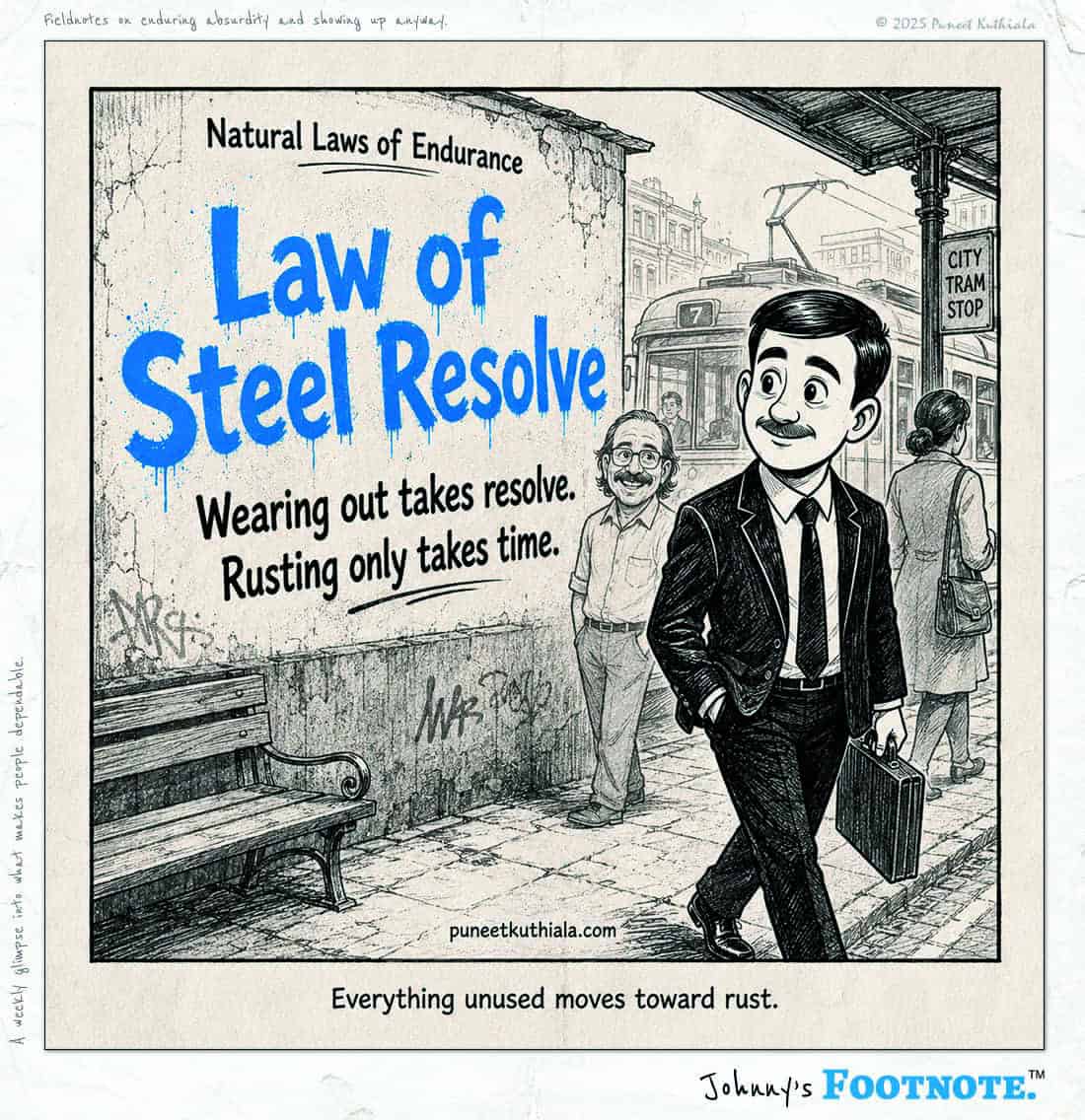
Law of Steel Resolve
Wearing out takes resolve. Rusting only takes time.
Before I tell you what John observed as he began in the system, I need to tell you what he was when he arrived. Not what he became, but who he was at the start.
John does not stop.
This is not something he developed here.
It is not a strategy built in response to his surroundings.
It is closer to his disposition: a way of being directed toward the work that does not depend on conditions being favorable, recognition being available, or effort being seen.
The fact that John did not stop was not immediately visible.
John’s consistency revealed it.
When things stall, he moves anyway.
When the week is bad, he delivers anyway.
When acknowledgment does not come, he continues anyway.
Repeated across situations, it ceased to feel situational.
I have watched him long enough to be certain of this.
It is not his stubbornness.
It is not about his performance.
For John, stopping requires a reason.
And the absence of momentum has never been enough.
Most people pause when the environment permits it.
What begins as an occasional pause becomes a pattern.
The system registers it, not visibly at first, but it quietly reallocates its attention.
Over time, the system registers it. Not visible at first, but the system quietly reallocates its attention. Work moves elsewhere.
Trust follows movement. What does not move is set aside.
John requires a reason to stop.
That set him apart.
Momentum is not a reward for resolve; it is the proof of it.
I found that line in my notes from those early days, before I realized I was recording anything of consequence.
I had seen the alternative often enough. Not failure, but quiet sidelining. Capable people, available, gradually excluded from what mattered.
Everything unused moves toward rust.
Meet John's Colleagues. They are here (& almost everywhere).
Follow the Genesis of the Laws

Humor from The Footnote







Core Body of Work


Explore More


